Understanding Poker Odds and Probabilities
In the dynamic world of poker, understanding the intricacies of odds and probabilities is crucial for players seeking to elevate their game. Whether you’re a seasoned veteran or a newcomer to the felt, mastering the mathematical underpinnings of poker can provide a significant edge in your decision-making process. In this comprehensive guide, we’ll delve into the fundamental concepts of poker odds and probabilities, equipping you with the knowledge to make informed choices and maximize your chances of success.
The Importance of Odds Calculation
Poker is a game of skill, strategy, and, most importantly, the ability to assess and manage risk. By understanding the odds and probabilities associated with various poker scenarios, players can make more informed decisions, minimize their exposure to unfavorable outcomes, and capitalize on favorable situations. Accurate odds calculation allows you to determine the likelihood of completing a desired hand, the expected value of a particular play, and the potential risk-reward ratio of your decisions.
Calculating Outs and Pot Odds
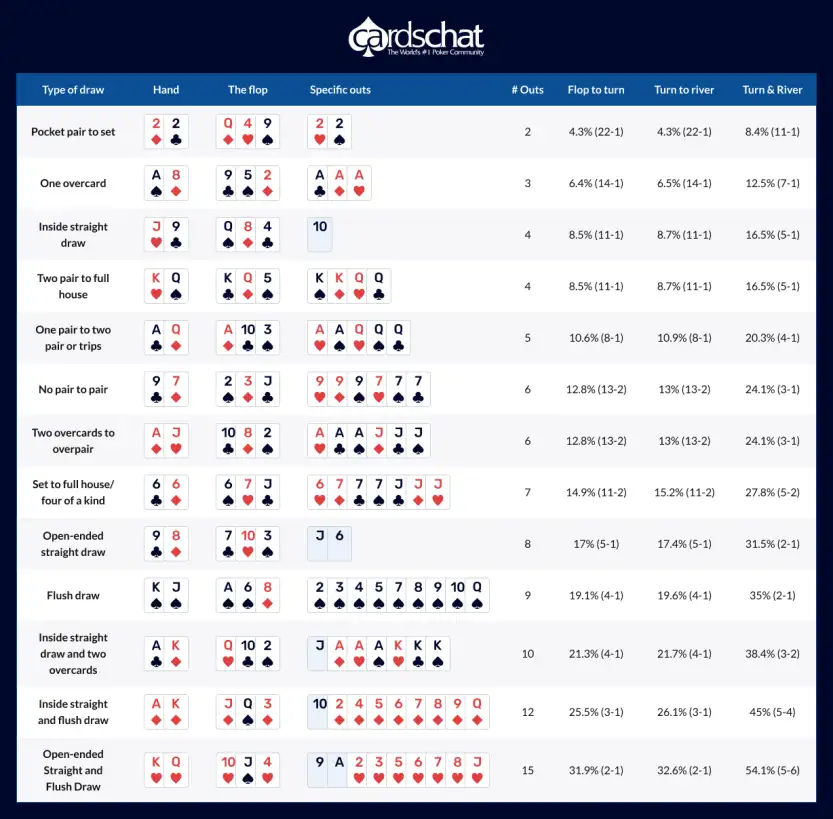
One of the core concepts in poker odds analysis is the concept of “outs” – the number of unseen cards that can improve your hand to a winning hand. By determining your outs, you can calculate the probability of completing your desired hand on the next card (the turn) or the final card (the river). This information, coupled with the size of the pot and the amount of your bet, allows you to calculate the pot odds – the ratio of the current pot size to the size of the bet required to continue.
The Rule of 2 and 4
The “Rule of 2 and 4” is a simple yet effective tool for quickly estimating your odds of completing a draw. When you have a flush draw (9 outs) or a straight draw (8 outs), you can approximate your probability of hitting the card you need on the turn by using the “Rule of 2.” This rule states that you have approximately a 2-in-1 (or 20%) chance of completing your draw on the turn. For the river, you can use the “Rule of 4,” which suggests that you have approximately a 4-in-1 (or 40%) chance of completing your draw.
Probability Calculations in Poker
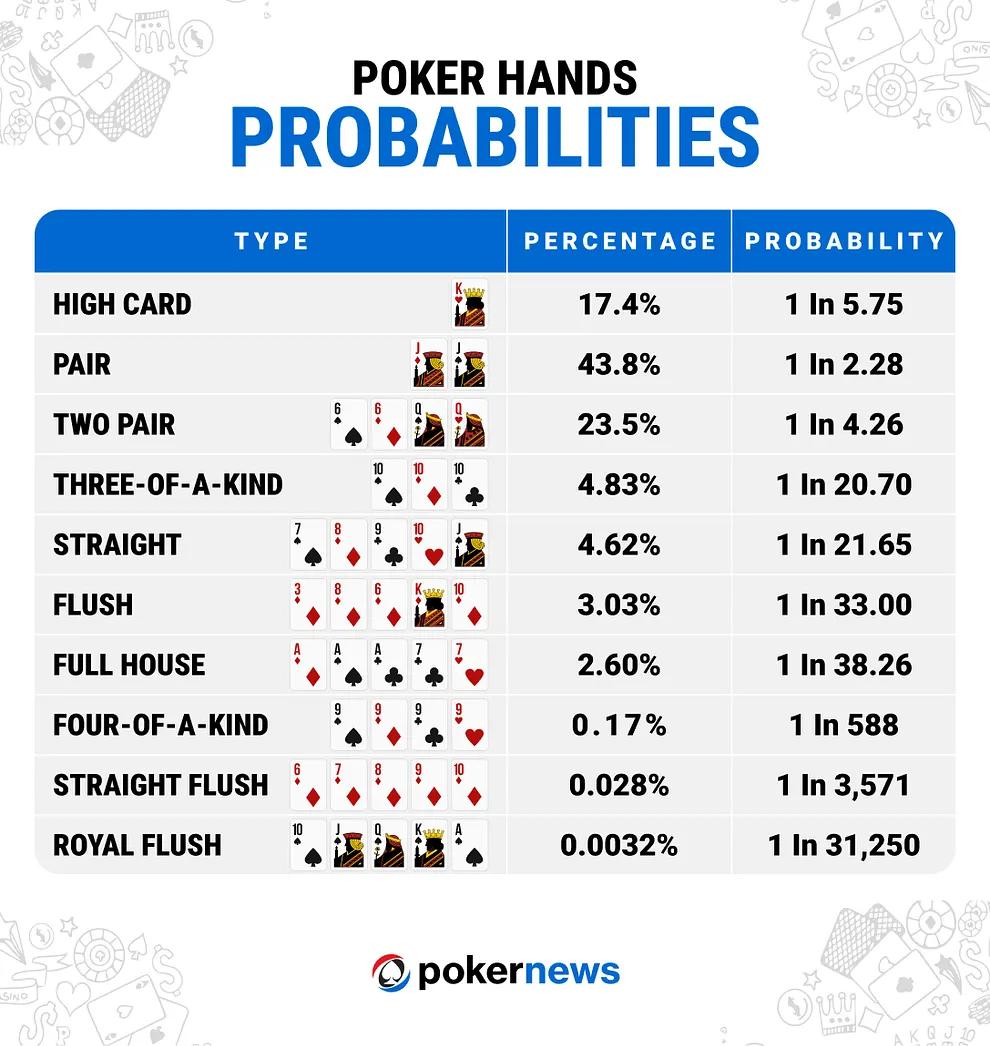
While the “Rule of 2 and 4” provides a quick and practical way to estimate your odds, a deeper understanding of probability calculations can offer more precise insights. By using the principles of combinatorics and the binomial distribution, you can calculate the exact probability of completing your draw, as well as the likelihood of your opponent holding specific hands.
The Binomial Distribution
The binomial distribution is a fundamental statistical concept that can be applied to poker scenarios. It allows you to calculate the probability of achieving a specific outcome (e.g., completing your draw) in a fixed number of independent trials (e.g., the remaining unseen cards). By understanding the binomial distribution and its properties, you can make more accurate assessments of your chances of success in various poker situations.
Combinatorics and Equity Calculations
Combinatorics, the study of counting and probability, plays a crucial role in poker odds analysis. By understanding the number of possible card combinations and the likelihood of specific hand rankings, you can calculate your “equity” – the probability of your hand winning a given pot. These equity calculations are essential for evaluating the expected value of your plays, making informed decisions, and optimizing your overall strategy.
Applying Odds and Probabilities in Poker Strategy
Mastering the concepts of poker odds and probabilities is not just an academic exercise – it’s a practical tool that can significantly enhance your gameplay. By incorporating these principles into your decision-making process, you can develop a more disciplined and profitable approach to the game.
Pot Odds and Implied Odds
Analyzing pot odds and implied odds is a crucial aspect of poker strategy. Pot odds represent the immediate risk-reward ratio of a particular play, while implied odds consider the potential future payoff if you complete your draw. By carefully evaluating these odds, you can determine the optimal times to call, raise, or fold, ensuring that you make decisions that maximize your expected value.
Hand Reading and Opponent Analysis
Poker is not just about the cards you’re dealt – it’s also about the cards your opponents may be holding. By applying your knowledge of poker odds and probabilities, you can engage in effective hand reading and opponent analysis. This allows you to make more accurate assessments of your opponents’ likely holdings, anticipate their potential actions, and adjust your own strategy accordingly.
Remember, responsible gambling is essential in the world of poker. While understanding odds and probabilities can provide a significant advantage, it’s crucial to always gamble within your means and seek help if you or someone you know is experiencing problem gambling behaviors.




Post Comment